Search our website
Call us FREE on
0808 196 6093
Open today 7am - 5pm
Treating waste as a cost and regulatory burden is a short-sighted approach. A positive attitude, shifting away from doing the minimum to making waste management a strategic asset, could be just what you need to unlock financial, reputational and operational gains.
Why does this matter? With tightening regulations, rising disposal costs and corporate sustainability pressures, there has never been a better time to make the transition to a proactive waste management strategy.
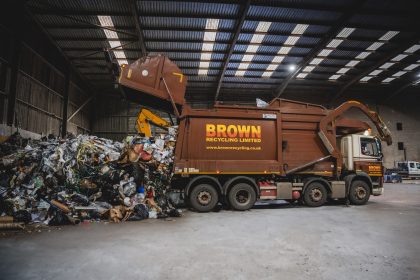
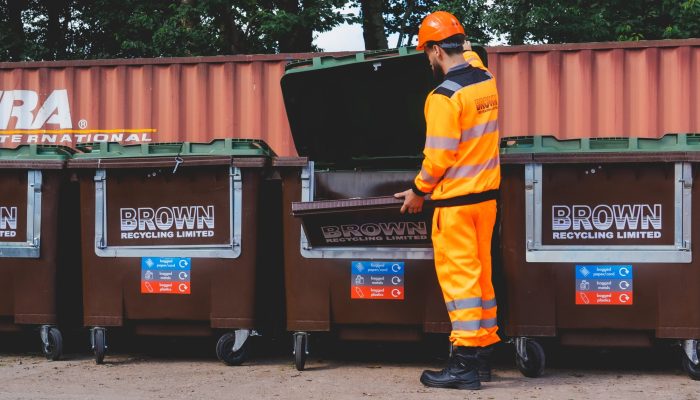
At Brown Recycling, we help our clients with large businesses and organisations across Staffordshire, Cheshire and the Midlands to turn their waste into an opportunity. That’s why we’re sharing our guidance on the competitive advantage of this approach.

Your duty of care as a business means you’re responsible for disposing of your waste via a licensed waste carrier. Further to this, you have a legal obligation under various regulations to meet compliance.
The most recent piece of legislation is the Simpler Recycling rules introduced in March 2025. This means any business in England employing more than ten FTEs (full-time equivalents) must separate their recyclables and food waste.
Not meeting the latest standards could lead to:
Compliance is just the beginning of the journey, however. It’s the minimum you should be doing to remain operational, shaping the view of waste as a cost and not an opportunity.
When you think only in terms of minimum compliance, you get siloed thinking, with waste bins and collection contracts, rather than creating a fully integrated system. If you stand still and stagnate, your competitors will get ahead and regulations will advance, leaving you behind.
So what are you missing? How can you show stakeholders, customers and those looking at ESG (Environmental, Social and Governance) frameworks that you can go beyond compliance?
Imagine if waste management were not just a compliance burden, but a strategic differentiator. How would that look? Here are three pillars of advantage:
By working to reduce waste volumes, improve segregation and capture value from your recyclable materials, you can lower costs associated with disposal. You may also be able to lower any landfill tax burden and reuse materials, such as turning waste into feedstock.
Committing to going beyond compliance will resonate positively with customers, investors and regulators. You’ll be able to post ESG and CSR (Corporate Social Responsibility) benefits that set your business apart when tendering for both public and private contracts.
If you use data, audits, process redesigns and streamlined logistics to create a circular economy, you can rethink aspects of your supply chain. Make yourself an early adopter of these advantages and lead the way when it comes to new regulations, as well as access to incentives and grants.
Now, let’s take those pillars of advantage and look at how they can be practically applied to your waste:
There’s so much more to waste management that we can deliver as your dedicated partner at Brown Recycling. As part of our tailored, site-specific proposals, we identify areas for improvement in large businesses with clearly defined targets. From waste audits to customised segregation and bin strategies, we help businesses to reduce costs, reduce risks and scale up their sustainability.
Contact us today for a free initial quote or to arrange a review of your waste in Staffordshire, Cheshire or the Midlands.
Jordan is a marketing professional with a degree in Broadcast Journalism and a CIM qualification in Professional & Digital Marketing. With over a decade of experience in B2B and B2C multichannel campaigns, Jordan has led projects across both digital and offline media. Outside of work, Jordan enjoys football, theatre, live music, and all things pop culture.