Search our website
Call us FREE on
0808 196 6093
Open today 7am - 5pm
At the time of writing, recycling in England is undergoing ‘one of the biggest changes to commercial and domestic waste management’ for centuries with the rollout of Simpler Recycling legislation. In a major culture shift, it will change the future of recycling and make amends for not prioritising it in the past.
Part two of this blog explores the history of waste management from 1970 through to the present day as well as what the future holds for the sector. You can also catch up on part one of how things have changed in 100 years of waste management, where we reviewed 1926 – 1970.
At the turn of the decade, the UK saw the establishment of the Department of the Environment (now DEFRA) in 1970 and in politics, The Green Party of England and Wales (then PEOPLE and later The Ecology Party) was founded in 1972, an indication of environmental awareness creeping up the agenda in Britain.
However, 1,226 local authorities across the UK disposed of waste primarily through landfill and something needed to be done to ensure better environmental protection.
Not long after many local authorities were amalgamated in a major overhaul to reduce this number, the new Labour government under Harold Wilson introduced the Control of Pollution Act 1974. It was enacted following a growing public concern about pollution and its effects on health and the environment. It primarily focussed on reducing activities that may cause pollution to the environment, including air, water, and land pollution. It also made proper waste disposal mandatory and set penalties for non-compliance.
In 1977, the UK’s first bottle bank came into use in Barnsley, South Yorkshire – marking an upturn in glass recycling rates from thereon in. It was the same year Brown Recycling (trading under the name H Brown & Son) welcomed a young Rod Brown into a mechanic role at the company. Almost 50 years later, Rod is still with the business in the role of Chairman as Brown Recycling celebrates 100 years’ service to its customers.

The Control of Pollution Act 1974 is still in effect today. Unfortunately, historical landfill construction methods significantly hindered any real environmental progress in its early years, as public concern over hazardous waste and legacy waste disposal sites continued to grow. Over 21,000 landfills in England built before the 1980s employed a “dilute and disperse” method, under the assumption that toxic and gaseous waste would seep into the soil, air and water and become harmless. In the ensuing years, right up to present day, the government has adopted a standardised European approach to operate landfill sites as full containment facilities with the aim of stabilising landfill sites within one generation. However, many of the original problematic facilities still remain to this day including many in Stoke-on-Trent.
In part one of our blog series, we revealed the story of Frank Rotherham Mouldings in Slough who invented the wheelie bin as we know it today, completely by accident. Well, by the late 1980s, local councils transitioned to kerbside plastic wheelie bins in a shift to reduce manual handling. For the first time, they could be emptied using mechanical lifting equipment fitted to refuse trucks.
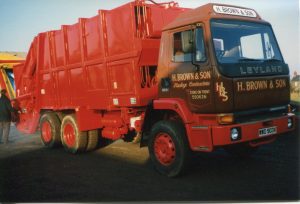
In a significant move to secure the future of Brown Recycling around the same time, the business bought out scrap metal merchants Singers (1989) under the stewardship of William Brown, to solely focus on waste management service. With this came our first permanent waste transfer site on Florida Close, Sneyd Hill. This kickstarted our scrap metal and skip hire recycling services, enabling the business to truly establish a name for itself in the sector.

Over the past 35 years, waste management in the UK has undergone a major revamp, with responsibility increasingly shared between government, businesses, and the public. Legislation change has slowly made recycling a part of daily routine, at home and in the workplace.
Under the newly introduced Environmental Protection Act 1990 came the Waste Duty of Care legislation. For the first time, any business that generated waste was now legally responsible for how it was handled and disposed of. Specifically, they had to store it safely, use licensed carriers, and keep transfer notes. In principle, this is how it remains to this day.
This was quickly followed up by the Landfill Tax of 1996, whose core aim was to reduce the overall levels of waste produced and send less of that waste to landfill. To achieve this, it charged site operators money based on the weight of waste sent to landfill, pushing more people toward recycling. Household and commercial waste started at £7 per tonne, and inactive or inert waste started at £2 per tonne.
Locally, the Stoke EfW (Energy from Waste) plant became operational in October 1998.
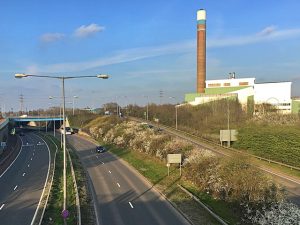
One of the city’s most prominent landmarks since it was built, the facility replaced the original 1989 plant after it was found to release 300 times the standard level of dioxins. This municipal waste site processes around 210,000 tonnes of non-recyclable household waste annually and generates over 15 megawatts of electricity to power over 30,000 homes.
The current incinerator, located on the A50/A500 junction (known as the D-Road to Potteries folk), is reaching the end of its lifespan and is set to be replaced by 2030. More on that later.
At the turn of the millennium, Brown Recycling were already well on their way to becoming the largest independent waste management provider in Staffordshire. This had been the primary objective of Rod Brown since taking over as Managing Director in 1993. In 2002, the business purchased a second future proofing site, Nevada Lane, and equipped it with a brand-new cardboard baling facility.
More environmental transformation followed in the early noughties as the UK embraced further European directives, formalised through the Landfill (England and Wales) Regulations in 2002 to prioritise recycling over disposal.
This was the same year the EU Waste Framework Directive came into effect, which introduced the waste hierarchy (prevention, re-use, recycling, other recovery, disposal) for UK businesses, plus a mandatory declaration on waste transfer notes.
At one point in time in 2011, Brown Recycling and indeed Stoke-on-Trent was the home of Europe’s first purpose built Solid Recovered Fuel (SRF) facility. This was right here on Sneyd Hill, as the business made every possible investment into cutting-edge green technologies with an eye on a sustainable future.
Brown Recycling has always been ahead of the curve or been quick to adopt formal change.
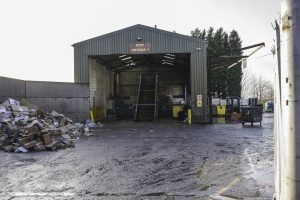
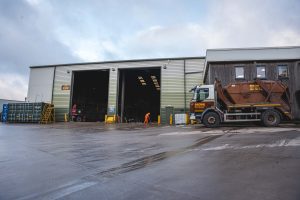
The early 21st century is defined by the circular economy model for UK waste management. The idea is that all waste is turned back into a resource at the end of its useful lifespan. By extracting more value out of existing materials, the aim is to reduce eradication of finite resources and ultimately, save the planet.
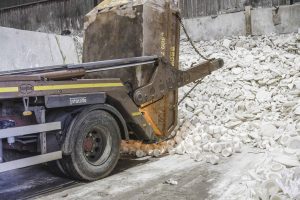
Everything that passes through Brown Recycling’s gates is assessed, sorted, and recycled or recovered for heat energy. Back in 2018, the company expanded the service offering to keep up with a growing number of recyclable waste streams and added a specialist confidential shredding facility to the Sneyd Hill headquarters. Despite rapid growth and adoption of modern recycling methods, tradition still runs through the business and even now, Brown Recycling still handles vast quantities of ‘shraff waste’ – the Potteries term for discarded moulds, used saggars and broken pottery – which regularly passes through our Florida Close site. It’s one of the clearest examples of the old and new coming full circle, and dates back to 1926 when our business started.
One such modern recycling method is Source Segregated Recycling (SSR). This Simpler Recycling compliant solution puts the onus on the customer to segregate food waste and recyclable materials from residual (non-recyclable) waste at source, rather than mix recyclable materials in one container to be separated later. This helps maximise recycling rates and produce higher quality recycling outcomes.
Simpler Recycling is the legislation implemented to create a more consistent approach to recycling across England. It is one of the biggest shake ups to waste management for decades and we’re all involved in making it work. In summary, it requires food waste, regardless of volume, and recyclable materials (cardboard, paper, plastic, cans and metal, glass) to be separated out from residual (non-recyclable) waste.
At work, it is the legal duty of every business to ensure their waste is sorted and collected compliantly. At home, food waste bins have been rolled out across the country to also meet this target. The goal is to end confusion over what can and cannot be recycled and increase recycling rates. It’s split out by a three-phase rollout, and to find out how and when you’re affected, read more on our Simpler Recycling page.
In late 2020, complaints about a problematic local landfill site began to hit headlines more frequently. This was Walleys Quarry, in Silverdale, Newcastle-under-Lyme, Staffordshire. Walleys Quarry closed in late 2024 but not before it had sparked outrage over the persistent foul-smelling gas that had affected local residents over a sustained number of years.
They had good reason to complain. The ‘eggy’ like smell was causing sickness and nausea, not to mention the site itself being a complete eyesore. The ‘Stop the Stink!’ campaign lobbied for full site closure and eventually won, bringing its operational lifespan to an end two years earlier than originally planned.
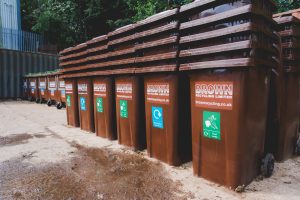
Environmental governance is now trendy, and the mindset of the population has shifted from forced change, to being a force for change. However, there’s still an awfully long way to go. Sustainability has become part of everyday decision-making for businesses especially through the insurgence of ESG and ISO policies where being more sustainable is not only a legal requirement but a competitive advantage.
Despite the progress made over the last decade, the UK’s waste management sector still faces significant challenges. Rising waste volumes, stricter environmental targets and increasingly complex waste streams mean the industry must continue to evolve.
The good news? Change is already happening.
The government continues to tighten regulations with greater emphasis on transparency, accountability and sustainable waste disposal outlets. One of the most significant developments is the mandatory rollout of Digital Waste Tracking (DWT) to be launched in October 2026, which aims to create a single, comprehensive system for tracking waste from the point it is produced to its final destination.
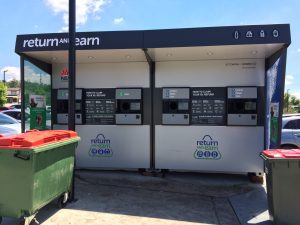
Furthermore, the Deposit Return Scheme (DRS) is scheduled to be launched from October 1st, 2027, across England, Scotland, Northern Ireland, and Wales (with Wales also including glass). However, the UK still lags behind many European countries that have already implemented DRS schemes, with Sweden leading the way as the earliest adopter in 1984. This will hopefully encourage businesses and the general public to segregate their plastic, cans and other bottles for monetary return.
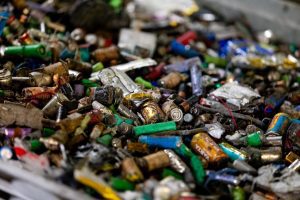
As new hazardous waste streams emerge, the industry needs to have an adaptive approach to handling their safe disposal and management. One waste stream receiving growing attention is the management of lithium-ion batteries, specifically in vapes. Whilst disposable vapes were banned in 2025, re-usable vapes are still composed of lithium-ion batteries, posing a major fire risk when incorrectly disposed.
Increasing fires across the waste management industry have led to the temporary closure of disposal sites, causing delays in waste processing. As a result, waste accumulates at other facilities, creating capacity pressures and increasing the risk of overloading the local waste management facilities.
To meet future demand locally, a replacement facility in Stoke is planned for construction between 2029 and 2030. The existing facility will reach 35 years of operation in 2030, marking the end of its serviceable life. Therefore, it has been concluded that a new Energy Recovery Facility (ERF) should be built at the Hanford site to ensure continued waste processing capacity and service reliability.
Another up-and-coming advancement is the role of AI in Waste Management, which we explored in greater detail in our blog Does AI Have a Role in Improving Recycling?
Conclusion
Over the last 100 years, waste management has undergone a remarkable transformation. What started as a largely landfill and disposal-led industry has evolved into one focused on recycling, resource recovery, environmental protection and sustainability. Along the way, legislation, technology and changing public attitudes have continually reshaped how we view waste and our responsibility towards it.
One thing is for sure. If the last 100 years have taught us anything, it’s that waste management never stands still. For us, five generations of the Brown family have witnessed first-hand how the industry has adapted to changing times and been there for all of it. We’re proud to have been part of that story and excited to see where the next 100 years will take us.
Jordan is a marketing professional with a degree in Broadcast Journalism and a CIM qualification in Professional & Digital Marketing. With over a decade of experience in B2B and B2C multichannel campaigns, Jordan has led projects across both digital and offline media. Outside of work, Jordan enjoys football, theatre, live music, and all things pop culture.